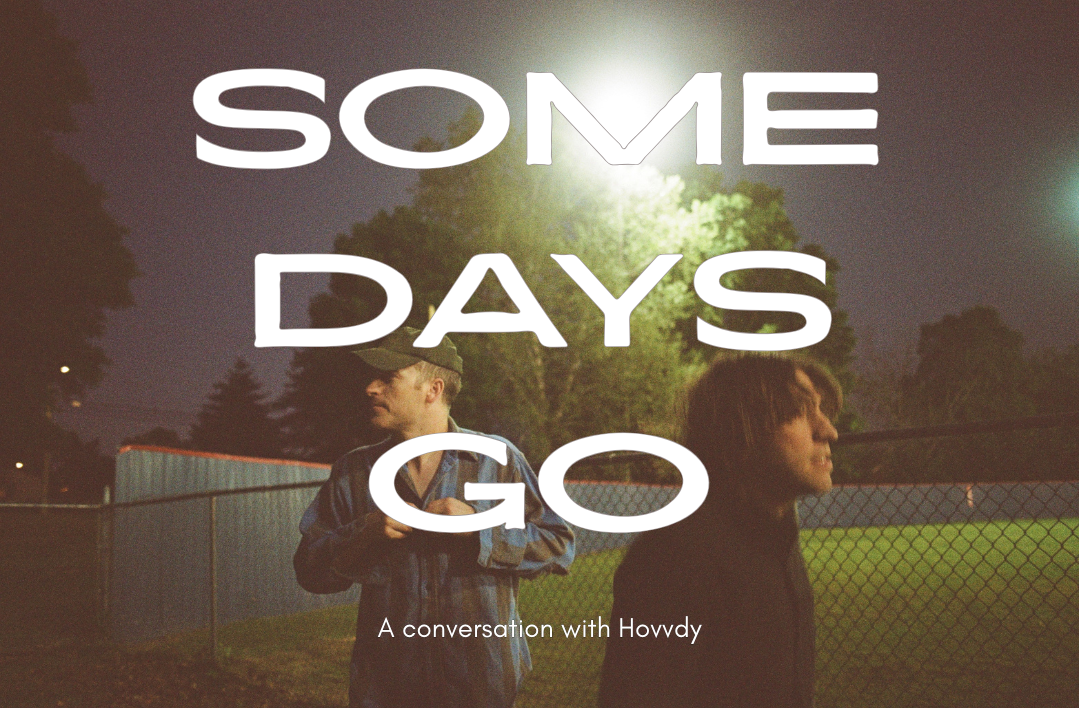
A conversation with Hovvdy

words & interview by tom johnson
photography by adam alonzo
"Love yourself, only you can do it. I know the world it can be so strange," Will Taylor sings plaintively on the new, and sixth, full-length album from Hovvdy, the project he's gently blossomed alongside long-time friend Charlie Martin since 2014. In many and immeasurable ways, it's a line that distills both the Big World LP, as well as Hovvdy's entire ethos, down into a few short words. Those words, their intention and substance, a delicate gossamer that's run through the band's entire body of work: subtle wonderings about the self, love in all forms, the endless peculiarity of both.
Big World, formed of twelve ruminative new songs, is a confounding experience. Will and Charlie's thoughts form odd, brazen shapes as they wind their way out into the world, but those same words feel more at ease in their own skin than ever before. They form into songs, notable by a directness we only really catch the coattails of as the whole dusty road opens up ahead and they wander off down it.
You could make the argument that the new record feels like a direct response to 2023's spiralling, sprawling, self-titled double album, the most complex and timely of their work to-date. But Hovvdy don't really approach their work in such a way, relying instead and only on construction of their craft, fixing the puzzle as the pieces arrive in their hands, only ever striving to be the best version of the band they can be in that moment. When they step away some kind of world has formed.
The processes that led to these new songs were different this time around; the results both similar but slightly different to what's come before. They are nuanced shapes, the shadows cast are played with and held, all of it self-contained even as the tempos change, the light shifts. Lush, heavy, decadent songwriting sits side-by-side with hip-hop style sculpting, a free approach that runs wild, echoing the contrasts that have always existed in the pairs shared work. In many ways it feels like an improbable balance honed over time, carved out now into another curious, and very often beautiful collection of work.
There's a run of songs in the opening half of the record, in fact, that I can't stay away from. It's all feels loose but significant from the outset, and then a shuffle of drums introduces 'JJ', a wurlitzer and mellotron drifting through, everything immediately weighty, rippled with the kind of ache that just draws you down into reverie. A special kind of gravity to it in the way that only a song can carry. Those same qualities bleed into 'What I Had' too, sweeter sound perhaps, words spoken with a little more clarity but all equally meaningful. The reflective quiet of morning light after a day you're already trying to keep a hold of.
In many ways, it feels like Hovvdy's magic trick, honed over time; the ability to evoke such things in others while writing so directly to themselves, their own experiences. More than ten years on it shows no sign of fading.
Ahead of their show in Glasgow, out on the European road opening for Wilco, one of their favourite ever bands, we spoke to Charlie and Will about those distances they've traveled, the intricate methods that helped summon Big World, and their own small and mighty places within it.
GoldFlakePaint: There was a lot of weight put on the last, self-titled record I guess due to its size and shape, and the processes involved to bring that whole collection together. How do you reflect on all of that now?
Will: I haven’t listened to in a while to be completely honest, but once this record came out, it was a nice time to reflect on the whole journey. It definitely took more effort. There were more people involved and we had a much bigger idea for it. I feel like what we had hoped for it was the perception it received. It was something so much bigger than we’d done before.
Charlie: We had never done the self-titled thing, and making the record it did start to feel like the one to do that with, and the right time to lean into that. You never know how it's going to be received, but when we put it out we did feel like it was probably the biggest splash that any of our records have ever made. It was gratifying for it to land like that.
And then seeing the way people talk about this new record in relation the previous one being our ‘break-out record’. It kind of felt like that to us, but it wasn't that extreme. We're always just trying to just notch it up a little bit every album. But that one was a grander statement, for sure.
GFP: Did that reception to Hovvdy make the journey to Big World feel any different? Did it feel like there was more weight on you and can you remember your initial thoughts about the next steps?
C: I remember our conversations, yeah. This is kind of boring, but we had signed with Arts & Crafts for the self-titled, and they had the option to pick up the next one which they did decide to. So at that point we just wanted to make another album without really thinking too hard about it. We knew that we wanted to do it with just myself and Will, and our buddy Ben (Littlejohn, Producer/Engineer). We wanted to keep it a little simpler, and do more of it ourselves. The self-titled had been a little more concepty. There were long conversations about what we were going to do and how we were going to do it. With Big World, we thought 'Let's just do the thing. Let's just start'.
W: We started this one in a different way, in that there were a couple songs that had lyrics, but most of them we recorded all the music for first, which was fun.
C: It's funny, but a lot of the press has it wrong. Most of them have said that we came into the studio with the craziest instrumentals you've ever heard and then we started making the record. But it was kind of the opposite, in that we went into the studio with some ideas and we made the instrumentals, then took them away to work on. We had some ideas, a chorus here, a verse there, and a small batch of songs that felt exciting. When we wrapped the session, we’d only made a handful of things, and then spent the next couple months, me and Will on our own, writing to the music.
It was cool. It was a totally new process. It was, in some ways, like making like a rap album, but it wasn't done in the studio. It was more so – or at least I can say for myself – just sitting at my desk, literally listening to the instrumental over and over, and just writing to it, as if it was a beat. I’ve never written in that way before.
W: That was certainly the case for me. I think it created an environment of response, which was something really cool.
"We knew we didn’t have a deadline, we didn’t even really have songs, so let's just hang and make good music. Let’s just make shit that is exciting to us" – Will Taylor
GFP: Had there been a discussion at the start of the process that you’d work that way? What instigated those methods?
W: I think it just revealed itself to us really naturally. We realised we didn't have all the songs going in, but we had the session booked with Ben, and we wanted to start. I feel like it was an idea that came up at some point when we agreed we didn’t need to stress about trying to finish all the songs in the studio. We could just record the music. I remember the first session that we did we had a lot of moments where we were like ‘I don't know what this song is yet’ but we just went with it.
C: Yeah, the original version of ‘You Will Go Far’ had loud live drums, and then we just scrapped that. So there wasn't the pressure of ‘we’ve got to make the album versions right now’, it was the opposite. We knew we didn’t have a deadline, we didn’t even really have songs, so let's just hang and make good music. Let’s just make shit that is exciting to us.
GFP: How long was that process?
W: The first time we all got together it was probably a little less than a week, maybe six days. That was when we started a lot of the songs. And then we met again in Nashville, but I feel like it was a much different part of the recording process then. We had songs that were living and breathing at that point.
GFP: How much are you sharing ideas in that time between? Are you talking to each other about the the lyrical side of things?
W: We were updating, for sure. As Charlie said, we do often return to our own little corners to finish our songs, and we usually do the lyric writing on our own but I can remember a few times where we joined in some way. There are a few songs that we co-wrote, quote-unquote, for the first time. We were also helping with melodies, but that was usually all done in-person. We're both bad on our phones though, we do better when we're together.
GFP: Do you think listeners – or maybe even yourselves – can hear that those songwriting processes have been done differently this time around?
C: Hmm, I don't know. I think the goal with us is always to make a song that feels solid as a rock, you know? That it’s airtight. Ideally the songs on Big World don’t feel like instrumentals with vocals tacked on top. You want it to feel all super cohesive. The biggest challenge for me was ‘Life So Wide’. I had the vocal melody fully written, because the guitar does the same kind of thing. That song's just me and Jamie McLaughlin, who played lead guitar all over the record, playing live together. It was one of the most beautiful sounding guitar recordings we've ever made, and it was a challenge to find the words to match, but I was just banging my head against the wall with it. So there was a lot of back and forth. Ideally, though, the song sounds like the song. Like it was always one and the same.
Whereas ‘Blast’ was way more hip-hop. For a while I had a different second verse, but when we were in the studio cutting vocals it just didn’t feel right. I ended up going out to the garage and wrote a new second verse in 20 minutes. I came back in and cut it right away, and that’s what’s on the record.
GFP: Do you think you were trying different things with the instrumentals because you weren’t concerned about lyrics and vocals at that stage? Were you trying to experiment more, or did you have a clear picture in your head of what you wanted it all to sound like?
W: It’s a good question. I feel like I wanted to try new things, and go for a dryer, less-produced sound. I feel like, in the past, a lot of the production of the songs that I've written have got any from me somewhere along the way, from the production side of things. Not to the point that I didn't like them, but it’s almost like I’d close my eyes and when I opened them the song was done. Sometimes you start something and it gets wheels, and you get excited about it; you're still uncertain about things but you just go with it. This time around we tried to be intentional about what everything sounded like, and it tended to be a little different in many ways. We recorded more of it live, and we had help with musicianship from some really talented musicians, which was a new thing for us too. I think, in slight ways, we wanted to really challenge ourselves musically.
GFP: One of my favourite moments on the record is that run from 'Starry' into 'Try Try Try'. They sit right next to each other but feel so different. I was wondering if you could talk to that contrast, and also how much attention you paid to the sequencing on this record?
C: I gotta credit Will on the sequence. I'm usually the one that starts grappling with the sequence first. I think It’s some Virgo / ADD thing, where I’ve gotta know if something is going to work way before we get there. But it’s something that’s really important to us. I was trying so hard, with so many different sequences, and I had almost, not given up, but come to the conclusion that maybe there wasn’t a perfect sequence. Mostly just because it's a small batch of songs but there's crazy range.
Tempo-wise, ’Starry’ is one of the slowest songs we’ve ever made, and ‘Try Try Try' is probably the fastest song we've ever done. ‘Life So Wide’ is so quiet, ‘Wannabee’ is so rocking. So it was a really tricky one, but Will cracked it. He just sent over this version and I was just like, yo, that's it. That's totally it. But yeah, we do think about that a lot. And we love it when it works, when it doesn't feel clunky. I also love that ‘Starry’ goes into ‘Try’ because I think about vinyl a lot with the sequencing. So that's it going from the end of Side A into Side B.
W: I feel like ‘Starry’ is that peak ethereal moment on the record and then it's a jolt into 'Try', which I think is really fun. I remember we were all chatting about the sequence we ended up with, and Charlie said about it being a DJ set style, rather than trying to pair songs that really speak to each other – and I can see that. It’s almost like you want to crank things up, then you want to pull it back down. You want to have a mid tempo. You want to have a relaxing song, then you want to have a banger.
C: We always usually try to stagger who’s singing too, but we threw that out the window.
"I wanted to go back to where I first found my confidence as a songwriter, which was going full stream-of-consciousness until it made me feel something in a very strong way" – Charlie Martin
GFP: Lyrically, I’ve always found your work to be quite ambiguous in the way you shape certain lines and phrases. I also read a review of Big World that said it was your most ambiguous album yet. Did you feel that yourselves?
C: I think we've both worked on hard on trying to become better and better as songwriters, and usually that correlates with becoming more clear and less ambiguous. Writing more traditional and straightforward songs that have an arc. With this record, I wanted to go back to where I first found my confidence as a songwriter, which was going full stream-of-consciousness until it made me feel something in a very strong way. Not sacrificing connection for the sake of it – still needing it to be deeply personal and deeply emotional, but being free with it.
W: I find that note interesting, because I think what makes our band so interesting is that me and Charlie can be coming from totally different angles at any given moment. For me, it’s our most lyrically direct record. A lot of the songs feel like me just telling something to someone. And I've never really done that. I've always talked about things that mean something to me, but with this record I genuinely feel like every song is pretty concise. There's no mystery. I'm literally just saying exactly what I mean. I think that's what makes our band so interesting, that we can be in different spots with it.
C: It's funny, because you can get to the point of the song’s significance in so many different ways. For example, ‘Starry’ was a song where it fit for me to be totally in a stream of consciousness. I wrote it super late at night and it all just fell out. It's not really about anything in particular, although obviously it’s tapping into some deep, subconscious shit. But when it came out, my godmother called me and said that song made her cry. Her saying that made me realise that she could potentially think it was about her. She's an artist, and I have a bunch of her pictures on the wall, and her thinking that made me super emotional. Even though it's not about her, the fact that it could hit like that for her is everything to me. I love that.
W: I feel like I’ve said this before, but sometimes the meaning of songs can reveal themselves so differently over time. You write them, and you think they mean something, and then you get some distance from it and zoom out, and you come to realise that it’s actually something deeper than you thought. Or that it's a pretty accurate descriptor of this other thing that’s happened.
C: For me, and this isn’t at all to compare myself to Rothko, or any artist like that, but if you ask them what a painting means… It’s just painting. You're just trying as hard as you can to make something beautiful and powerful. It's all coming from the same place. That's all it is.
GFP: One of the prominent reviews of Big World described it as the sound of you "finding relief rather than anxiety". I found that an interesting way of looking at the song, and was curious about your take on it.
W: It’s always really fun to read anyone's interpretation of the work. Relief rather than anxiety? I don't know about that one. I think there's been a natural kind of relief to our music, so maybe that’s a new phrasing of what's been said about our band before. There's a melancholy tone to our music, but it’s also self-assured, and we’re comfortable in that. I think we've maybe had more anxious songs or records, but I don't know about that one. A lot of the lyric writing was a lot more direct but I think that comes from a place of uncertainty, for me. When there is anxiety a lot more specificity comes out in my writing. So yeah, I don't know.
What I think is really interesting, and I'm just realising it in this conversation, is that me and Charlie did approach this record in quite different ways, which I think is cool. I think that’s what makes our band special. So I think it's hard to say exactly, but I think there is some truth to that generally speaking. I think we're more comfortable as humans, and as musicians, and as songwriters than we've ever been. So that would be a natural read.
C: Yeah. It's funny. I feel like maybe it means we did a good job, if people feel that way. But in reality, I was really going through it on this record.
GFP: I think that’s what interested me about that idea. There's a breeziness in place, but it doesn't necessarily feel like a light record to me, even with that sense of purpose or self-assurance.
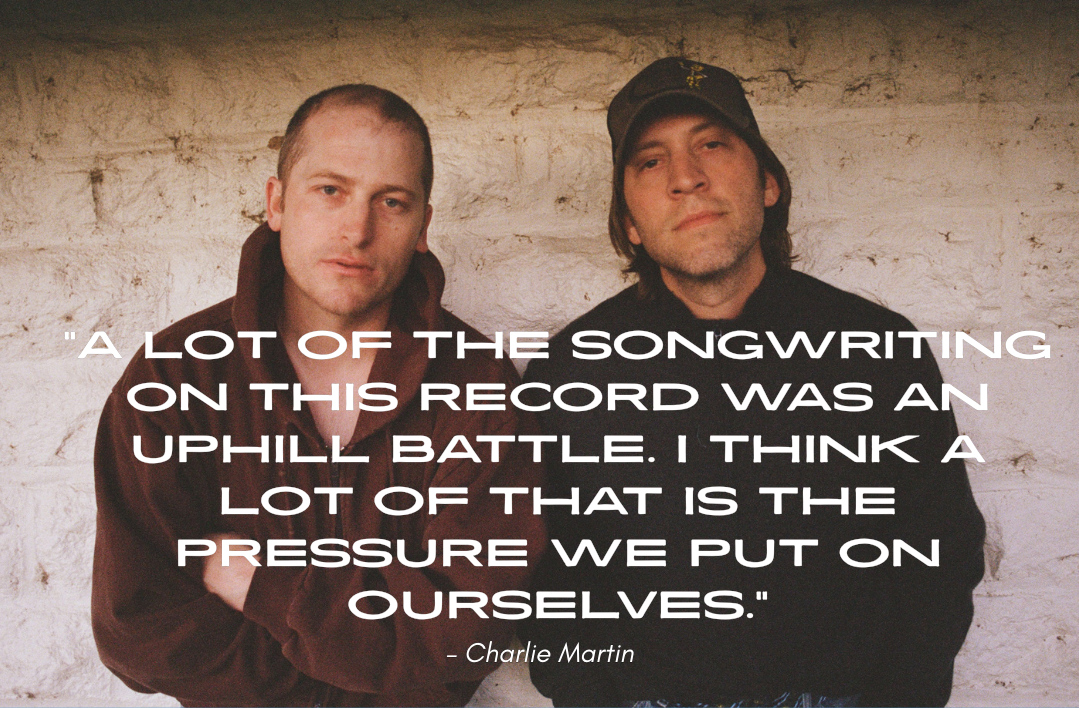
C: Yeah, and while I’m always hesitant to call it writer's block, a lot of the songwriting on this record was an uphill battle. Not an in a bad way, just in a way that maybe I hadn’t ever experienced before. I think a lot of that is pressure that we put on ourselves.
W: And the fact that we've been a lot busier writing songs with other people recently.
C: Yeah. We live in Nashville now and are in that session-songwriting thing. We're doing that pretty regularly and when we're doing that work, it's like we gotta write the fucking best song we can because we’re it for someone else. And I've never thought like that with Hovvdy. I had never quite put that level of pressure on myself. The songs on Taster were the first songs I ever really wrote. And I always said ‘I'm not good at this, I just want to do it. And I think I can make it cool'. So if the lyrics were not super heavy hitting, it didn't matter because they were really quiet in the mix anyway! So it's been a journey to go from that to where we are now as songwriters. We gotta make really fucking good songs.
W: I remember that once it became time to start, and people on our team began asking where we were with ideas for the next record, for a while I just didn't have any songs. And I honestly wasn't scared about that. I just trusted that they would come. If there's a bright side to writing more songs of my own, it’s that it has solidified my internal voice and what I want to say. My voice both as a songwriter and an artist, in some ways were harder to grab, but once they were there, they were clearer than they've ever been. And I think that goes back to the lyrical directness. I feel like the lyrics on this record are very plainspoken, and I think it comes from that journey.
GFP: I guess this ties into that journey a little, but we were chatting before the interview started about it being more than 10 years now since I wrote about ‘Problem’ and that whole album coming out. And I was wondering how much space do you give to reflecting on that journey?
W: Yeah, that’s wild. So cool. We do reflect, and it's changed a lot for us in that time. When the band started it was more acceptable, and more encouraged, even, to be somewhat mysterious. To be offline, or off the grid. That’s been flipped completely, and now you're encouraged to be the opposite, and to be very present online. It's fun to reflect on those kinds of things. But it's a blast to reflect on what we've done. We’ve put a lot of music out!
C: I think probably what forces us to do that kind of reflection are things like this Wilco tour.
W: Right, exactly.
C: If you told us back then that we were going to be out with Wilco in 2026, we’d know that we were doing something right. We've accomplished a lot, even though we still feel like it's just onto the next thing. Our success has been such a slow burn, though. We’ve never had the big fucking moment of a fully sold-out tour, or something like that. It’s always been that we just keep our head down and make records. Ideally, every record feels really exciting for our fans, and ideally they tell more people about us. Then you play the shows, and it's grows slowly. So it's easy, in some ways, to lose sight on it, and remember that actually a lot has happened. Like six albums in ten years, I didn't really clock that. That does sound a lot compared to other bands that I love. But for us, it just hasn't ever really felt that crazy.
W: It's also a pretty amazing feat considering how long the fifth record took!
C: Yeah, and we've done ‘Billboard for my Feelings’, and two different covers EPs. It's a lot of music!
W: We’ve grown up in the industry, in many ways, and that kind of age and experience means the goalposts move, and your goals change. But I feel like now, with the way the music industry has been streamlined, it means we’re competing with people like Taylor Swift to be on ‘Indie Music’ playlist. When the band started, we were looking to our peers, and we were comparing ourselves to those who might be a little bit more successful than us. There seemed to be a scene then that we could sink our teeth into, and if there were little wins within that scene, then you're growing, right?
Whereas now, it's just harder to poke through. The scenes have all kind of joined into one stream of endless music, at least from my perspective. And so the wins can feel lesser, I think. All of that to say; that’s why things like the Wilco Tour are so meaningful to us. Even this whole year of touring, in fact. Getting to go out with Bleachers was really fun; getting to hang with Jack Antonoff was really interesting, and fun to talk about, and would have blown our minds five or ten years ago. But it is interesting how much things have shifted. With all the new music that comes out every day it’s more difficult to find those small wins, but it also just makes me more thankful for our fans, and that we get to keep doing this.
Big World is out now, via Arts & Crafts
Find it on Bandcamp